Pages

Showing posts with label I/D. Show all posts

Wednesday, March 19, 2014

I/D #3: Unit Q: Pythagorean Identities


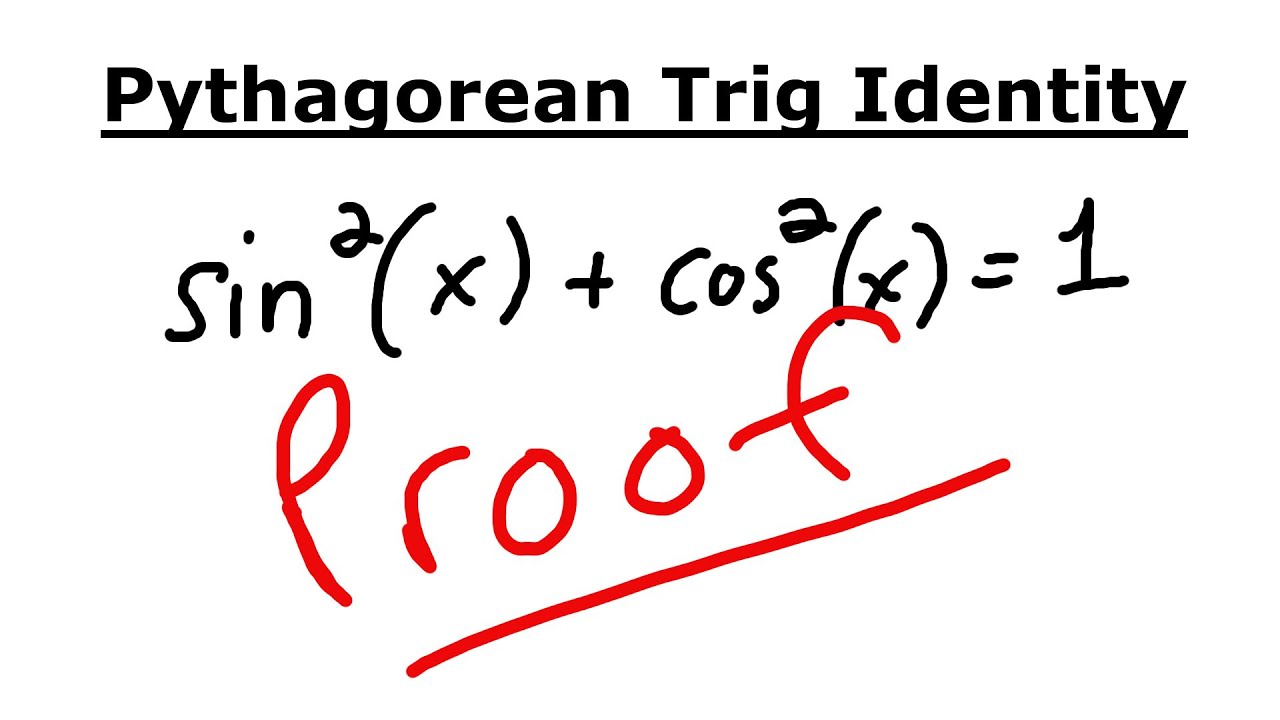
1. Where does sin²x + cos²x  = 1 come from?

http://i1.ytimg.com/vi/o-fAx_96lgw/maxresdefault.jpg

Well, let's start by defining this as the main Pythagorean Identity. So what is an identity? They are proven facts and formulas that are always true, so we can go ahead and manipulate the expressions and equations. The equation that we can manipulate (not redefine) is the Pythagorean Theorem because it  is also an identity that will help us help us derive sin^2x+cos^2x=1.
So let's back up a little. The Pythagorean Theorem is a^2+b^2=c^2. However, when referring to a unit circle, the Pythagorean Theorem is written as x^2+y^2= r^2.
The Unit Circle
http://www.contracosta.edu/legacycontent/math/Pythagoras.htm
This is how the Pythagorean Theorem is drawn on the unit circle, with r=1. So how do we get r^2 to equal 1? We simply do divide it all by r^2 (both sides)

x^2 + y^2 =r^2
                               >>>  (x/r)^2 + (y/r)^2 = 1    We cancelled off r^2
r^2     r^2   r^2

Now, take a closer look at the fraction and what do you see? Anything familiar, perhaps the ratio for cosine and sine on the unit circle?? Yes? Yes!
Based on one of previous units, we found out that the ratio for cosine is x/r and the ratio for sine is y/r. Notice how they are written the same way, except that they are both squared. So we can just replace the ratios by the trig function name. Therefore, we get: sin^2x+cos^2x=1
This helps prove the reason why the Pythagorean Theorem is an identity since it can be manipulates, but the facts and formula is always the same even though a little rearranged.
Let's actually prove that this works though. Since we are talking about the unit circle, we can use one of the "Magic 3" pairs from the Unit  Circle. Let's use 45 because it has different x and y values.
The ordered pair is :(√2/2)>>>> Substitute them in the equation:  (√2/2)² + (√2/2)² = 1. (√2/2)²
When we simplify it, we get (1/2) + (1/2)=1, so this helps us prove that then identity is true!


Now we can proceed to find the next two Pythagorean Identities:
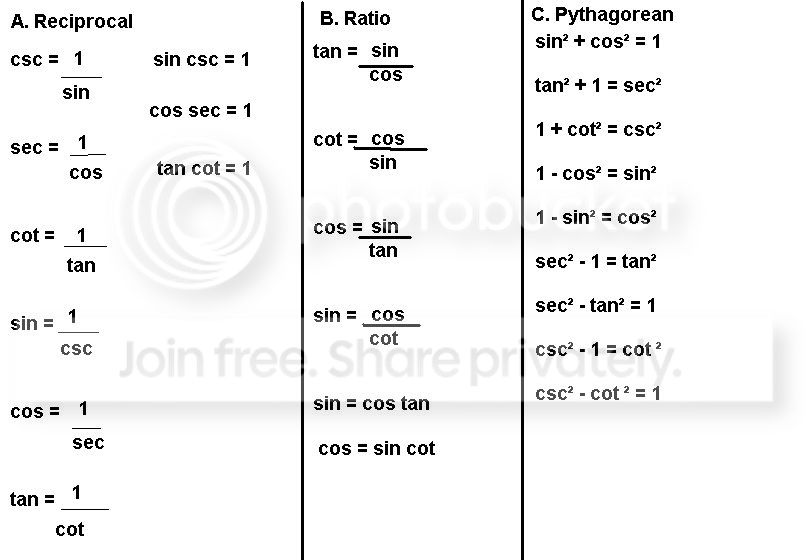
We can first find the tangent derivation by dividing the main identity by cos^2/x.

sin^2x   +   cos^2x    =    1
                                                                >>  tan²x + 1 = sec²x.                         The cos^2x cancel to equal 1
cos^2/x       cos^2/x     cos^2/x                                Then we find the rest by using the ratio/reciprocal identities


It is very important to remember the ratio identities in order to make your life easier and know where we get our substitutions!
Image
http://www.sosmath.com/CBB/viewtopic.php?t=41908

Now we can continue to find cotangent derivation by dividing everything by sin^2x
sin^2x   +   cos^2x    =    1
                                                                >>  cot ²x + 1 = csc²x                The sin^2x will cancel to equal 1
sin^2x         sin^2x       sin^2x                                 Then we find the rest by using the ratio/reciprocal identities


Inquiry Activity Reflection:
1. The connections that I see between Units N, O, P, and Q so far are that the unit circle and the trig functions will continue to reappear and help define most of the trig functions and anything that relates to it even though equations are always being rearranged. Also, I learn the significance of sin and cos because all trig functions eventually relate back the them. It is almost like the universal trig function. 
2. If I had to describe trigonometry in THREE words, they would be... interconnected, confusing,and mind-blowing. 

Tuesday, March 4, 2014

I/D #2: Unit O - How can we derive the patterns for our special rights triangle?

HEADING FOR THIS SECTION: INQUIRY ACTIVITY SUMMARY Please click here to watch video


HEADING FOR THIS SECTION: INQUIRY ACTIVITY REFLECTION

Something I never noticed before about special right triangles is how they all connect one way or another. I knew that triangles all add up to 180 degrees, but I had forgotten that if you divide the triangle by half, you get a right triangle and then a 30-60-90. Of course, the 45-45-90 also derives from another shape, but this time it is the square. I never noticed that the triangle is simply a ratio that will always remain the same even as the triangles expand.

Being able to derive these patterns myself aids in my learning because I can always rewrite the pattern in case I happen to forget. It would only really take me knowing the Pythagorean theorem, which I hope to never forget. Finding out the pattern is actually really simple and now I have the ability to easily figure it out simply by finding the angles measurements of a triangle and not by memorizing the sides, but by actually understanding the factors of triangles.

Saturday, February 22, 2014

I/D #1: Unit N Concept 7: How do SRTs and the UC relate?


Inquiry Activity Summary:


Inquiry Activity Reflection:

  1. The coolest thing I learned from this activity was how to base my answers from one single quadrant with the three different right angles. In geometry, I would have never thought that I would see the special right triangles as much as I do now, but I am glad that I remembered them.
  2. This activity will help me in this unit because I know that I am bound to forget the circle if I am ever nervous or simply cannot remember, so this activity will really help me get one quadrant organized and thus, the entire unit circle. It also allowed me to see the relationships that the degrees have with their sides and how the sides related to the circle as a whole.
  3. Something I never realized before about special right triangles and the unit circle is how it always has the same numbers even though it seems to be a lot more. The amazing thing is that thiese numbers relate to the special right angle triangles, so it is easy to figure out what numbers are needed.